Shipping Container Bitcoin Mining Cost in 2026
Shipping Container Bitcoin Mining Cost in 2026
Post Tags:
How Much Does a Shipping Container Bitcoin Mining Setup Cost in 2026?
| QUICK ANSWER
✓ A 20ft air-cooled container mining setup starts around $15,000 before miners; a 40ft unit runs $40,000–$70,000. ✓ Hydro and immersion-cooled builds cost $112,000–$300,000 before hardware, but handle far more heat per square foot. ✓ ASIC miners add $4,000–$15,000 per unit on top of the container, and electricity is 60–80% of your ongoing cost. ✓ At sub-$0.05/kWh power, payback can land in 12–24 months; at $0.08/kWh, plan on 5–6 years. |
If you have priced out a shipping container Bitcoin mining setup, you already know the range of quotes online is enormous — anywhere from $15,000 to $300,000 depending on who you ask. That spread is not a pricing error. It reflects three very different products: a bare air-cooled shell, a mid-tier unit with real airflow engineering, and a hydro or immersion system built for dense, 24/7 industrial mining. This guide breaks down what you actually pay for at each tier in 2026, what drives the cost, and how long it realistically takes to earn that investment back.
What Is a Shipping Container Bitcoin Mining Setup?
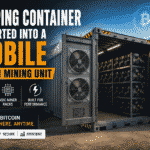
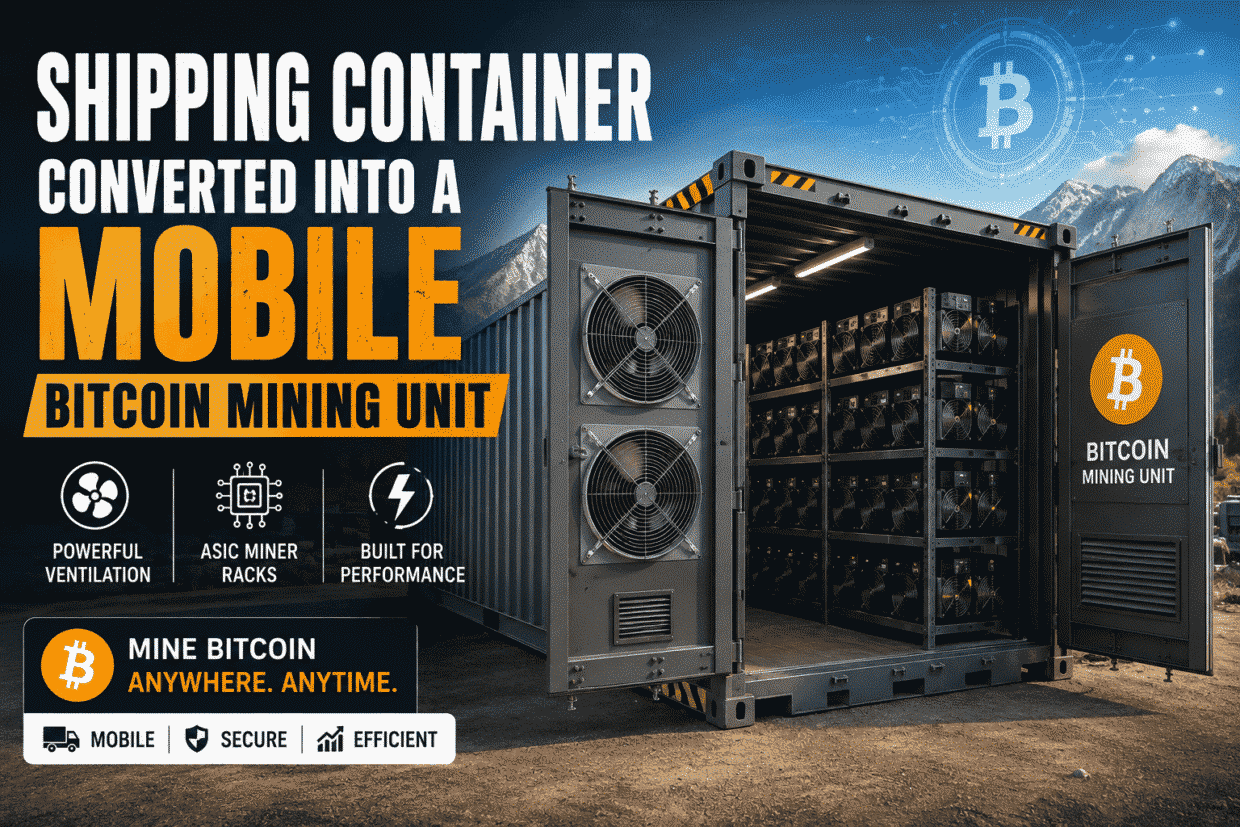
A container mining setup is a standard 20ft or 40ft steel shipping container retrofitted to house rows of ASIC miners — the specialized machines that solve the computational puzzles securing the Bitcoin network. Instead of building a data center from scratch, operators convert an existing container with reinforced electrical infrastructure, cooling systems, fire-suppression material, and rack mounts. The appeal is straightforward: a container is mobile, weatherproof, stackable, and can be dropped onto a site with power access — a solar farm, an industrial lot, or land next to a substation — far faster than a permanent building.
Container mining units are generally sold in three configurations. Air-cooled units use high-volume fans to pull heat out through vented panels and are the cheapest to buy and run. Water-curtain or water-cooled units add a liquid-cooling layer that lets you pack in more miners per container without overheating. Hydro and immersion units submerge or closely bathe the hardware in a cooling fluid, which is the most expensive setup but supports the highest miner density and the longest hardware lifespan.
Container Mining Costs by Type (2026 Pricing)
Pricing depends almost entirely on container size and cooling method. The table below reflects typical 2026 market pricing for the container and cooling infrastructure only — ASIC miners are priced separately below.
| Setup Type | Typical Cost (Container Only) | Miner Capacity | Best For |
| 20ft air-cooled | From ~$15,000 | 100–250 units | Small operators, testing a site before scaling |
| 40ft air-cooled | $40,000–$70,000 | 250–600 units | Mid-size farms with standard grid power |
| Hydro / immersion (20ft–40ft) | $112,000–$300,000 | 240–420 slots | High-density industrial mining, cheap power sites |
On top of the container, budget for ASIC hardware. As of 2026, current-generation miners such as the Antminer S21 series typically run $4,000 to $15,000 per unit, with efficiency-focused models commanding the higher end because they squeeze more hashrate out of every kilowatt. A fully populated 20ft air-cooled container running 150 mid-range miners can therefore represent a $600,000–$1.5 million hardware investment on top of the container itself — which is why most operators scale gradually rather than filling every slot on day one.
What Actually Drives the Cost Up or Down
- Cooling method: air is cheapest to install but limits density; hydro and immersion cost far more up front but let you run more miners per container without thermal throttling.
- Container size: a 40ft unit is not simply double a 20ft — reinforced electrical distribution and structural upgrades scale the price faster than the floor space does.
- Power infrastructure: transformers, breaker panels, and cabling rated for 400 kW to 1.5 MW of continuous draw are a major line item that is easy to underestimate.
- Site prep: pad or foundation work, grounding, and utility hookups can add tens of thousands of dollars depending on the site.
- New vs. refurbished container shell: a factory-new container costs more than a converted used one but avoids hidden structural or corrosion issues.
How Long Until a Container Mining Setup Pays for Itself?
Return on investment for container mining is driven by four variables: your electricity rate, hardware efficiency, the price of Bitcoin, and network difficulty — the last two of which you cannot control. Electricity typically represents 60–80% of ongoing operating cost, which is why the single biggest lever an operator has is securing cheap, reliable power.
| Electricity Rate | Typical Payback Period | Notes |
| Under $0.05/kWh | 12–24 months | Achievable with industrial contracts, stranded/flared power, or on-site solar |
| $0.06–$0.07/kWh | 2–4 years | Typical for standard commercial grid power in many regions |
| $0.08/kWh and up | 5–6 years | Payback stretches significantly; margins are thin unless hardware is very efficient |
Because power cost swings the payback period by years, not months, the smartest first step before buying any container is locking in a real electricity quote for your exact site — not a national average.
Inside a Real Container Mining Unit: What a Turnkey Build Includes
To make this concrete, here is what a manufactured, ready-to-run mining container typically includes, using a 20ft modular unit as the reference point. The build timeline generally spans about 90 days from order to power-on, broken into three phases: production and internal fit-out, freight and shipping, and on-site installation and commissioning.
- Standard 20ft container footprint, compatible with common rack layouts for ASIC miners across major brands, including Antminer, MicroBT (Whatsminer), and Canaan Avalon lines.
- Dual-layer water-curtain cooling combined with a bank of negative-pressure fans, engineered to hold internal temperatures around 28°C even under full mining load.
- Fire-retardant internal materials and a fire-detection layer, since dense electronics running 24/7 need real fire risk mitigation, not just good ventilation.
- An emergency escape push-lock on the access door — a small detail, but one that matters if a technician is inside during a fault.
- Construction that references CE and UL safety standards, which matters if you are sourcing equipment for use across different countries or jurisdictions.
None of this replaces doing your own due diligence on any specific manufacturer, but it illustrates the difference between a bare steel box with some fans bolted on and an engineered mining container built to run unattended for years.
DIY Conversion vs. Buying a Turnkey Container
| Factor | DIY Conversion | Turnkey / Manufactured Unit |
| Upfront cost | Can be lower if you already have a container and basic tools | Higher, but cooling and electrical are pre-engineered |
| Time to power-on | Weeks to months, dependent on your contractor availability | Typically ~90 days from order, on a fixed timeline |
| Risk | Cooling or electrical mistakes can damage hundreds of thousands in ASICs | Cooling and safety systems are pre-tested before delivery |
| Best for | Experienced operators with in-house technical crews | First-time buyers or anyone scaling past a single test unit |
Questions to Ask a Container Mining Manufacturer Before You Buy
A detailed quote should answer every one of these without you having to chase for follow-up information. If a supplier cannot answer these clearly, treat that as a warning sign.
- What is the guaranteed continuous power draw the unit is rated for, in kW, and what happens if my site cannot supply it?
- What cooling method is used, and what internal temperature does it maintain at full miner load in a worst-case climate?
- What is the full build and delivery timeline, broken into production, shipping, and on-site installation?
- What fire detection and suppression systems are built in, and do they meet a recognized safety standard?
- Is the container new or refurbished, and what warranty covers the structure versus the electrical and cooling systems separately?
- Can the unit be relocated after installation, and what is involved in disconnecting and moving it?
- What ongoing maintenance does the cooling system require, and is remote monitoring included?
Common Mistakes First-Time Buyers Make
- Sizing the container before sizing the power supply — always confirm your site can actually deliver the continuous kW draw before ordering miners.
- Choosing air cooling for a hot climate without modeling summer performance, which throttles hashrate exactly when electricity is often most expensive.
- Underestimating noise and permitting requirements — container mining units are loud, and many municipalities regulate them as industrial equipment.
- Buying miners and the container from unrelated vendors with no coordinated support, which makes troubleshooting cooling or power issues far slower.
- Ignoring resale and mobility value — one advantage of a container over a fixed building is that it can be relocated if power costs or regulations change.
Is a Container Mining Setup Right for You?
A shipping container Bitcoin mining setup makes the most sense if you have access to genuinely cheap or otherwise underused power, want the flexibility to relocate hardware without abandoning a building, and are prepared to treat this as an industrial equipment purchase rather than a hobby upgrade. It makes less sense if your only available power is standard residential-rate electricity, since at $0.10+/kWh the payback math rarely closes in a reasonable timeframe. Before committing, get a written electricity quote for your exact site, confirm local zoning and noise rules, and request the cooling and safety specifications in writing from any manufacturer you are considering — not just the headline price.
Good fit if you:
- Have a quoted electricity rate under roughly $0.07/kWh, or access to stranded, flared, or curtailed power.
- Need to deploy quickly on a site that cannot support a permanent structure, or may need to relocate within a few years.
- Have in-house technical capacity, or a support contract, to monitor cooling and electrical systems 24/7.
Probably not a fit if you:
- Are paying standard residential electricity rates with no path to an industrial or bulk rate.
- Are looking for a passive, hands-off investment — mining hardware requires monitoring, maintenance, and eventual replacement as efficiency standards rise.
- Are in a jurisdiction with unclear or restrictive rules on industrial crypto mining equipment.
Key Terms to Know
A short glossary for anyone new to this space, since the terminology gets thrown around loosely in pricing quotes:
- ASIC (Application-Specific Integrated Circuit): a chip built to do one job — solving Bitcoin’s mining algorithm — far more efficiently than general-purpose computer hardware.
- Hashrate: the speed at which a miner or container performs those calculations, usually measured in terahashes per second (TH/s).
- Network difficulty: an automatic adjustment to how hard the mining puzzle is, which rises as more total hashrate joins the network and directly affects how much any single container earns over time.
- Immersion cooling: submerging miners directly in a non-conductive cooling fluid, the densest and most efficient — but most expensive — cooling method available.
- Curtailment/stranded power: electricity that is generated but not fully used by the grid, often sold at a steep discount and a common power source for container mining sites.
Where Container Mining Fits Into the Modular Building Trend
Container-based Bitcoin mining is part of a much broader shift toward modular, purpose-built container conversions — the same underlying idea behind converting containers into grow farms, mobile kitchens, or workspace pods. The advantage is consistent across all of these use cases: a steel container is weatherproof, transportable, and faster to deploy than a ground-up structure, whether the end use is agriculture, hospitality, or computing. If you are evaluating a mining container, it is worth understanding these adjacent product categories, since the same manufacturer relationships, financing structures, and site-prep considerations often carry over.
Frequently Asked Questions
How much does a 20ft Bitcoin mining container cost in 2026?
A 20ft air-cooled mining container typically starts around $15,000 for the container and cooling infrastructure alone, not including ASIC miners. Hydro or immersion-cooled 20ft units cost significantly more, often well into six figures, because of the added cooling engineering.
Do I need to buy the ASIC miners separately from the container?
In most cases, yes. Container pricing usually covers the shell, electrical distribution, and cooling system, while ASIC miners are quoted separately at roughly $4,000–$15,000 per unit depending on the model and efficiency tier.
How many miners fit in a shipping container?
A 20ft air-cooled container typically houses 100–250 miners, a 40ft air-cooled container holds 250–600, and hydro or immersion-cooled units are usually rated for 240–420 slots depending on the density of the cooling system.
What is the realistic payback period for a container mining setup?
Payback depends heavily on your electricity rate. At under $0.05/kWh, 12–24 months is achievable. At a more typical commercial rate of $0.08/kWh, payback often stretches to 5–6 years, since electricity accounts for 60–80% of ongoing operating cost.
Is air cooling or hydro cooling better for a mining container?
Air cooling is cheaper to install and adequate for smaller, lower-density setups, especially in cooler climates. Hydro and immersion cooling cost more upfront but support higher miner density and better long-term hardware performance, which matters more as you scale.
Can a mining container be moved once it is set up?
Yes — mobility is one of the main advantages of container mining over a fixed building. A container can be relocated to a new site if power pricing, regulations, or availability change, though moving a fully populated unit requires care with the electrical and cooling connections.
How long does it take to get a mining container up and running?
A manufactured, turnkey unit typically takes about 90 days from order to power-on, covering production and internal fit-out, freight and shipping, and on-site installation and commissioning.
What safety features should a mining container have?
Look for fire-retardant internal materials, fire detection, an emergency escape mechanism on the access door, and construction that references recognized safety standards such as CE and UL. Dense electronics running continuously carry real fire risk, and cutting corners here is not worth the savings.
Is Bitcoin mining in a shipping container legal everywhere?
Regulations vary significantly by country, state, and even municipality, covering zoning, noise, and electrical permitting. Always confirm local rules before purchasing or installing a container, since requirements differ by jurisdiction and change over time.
What electricity rate do I need for container mining to be profitable?
Most profitable operations run on power priced well under $0.07/kWh. Above roughly $0.10/kWh, the payback period typically becomes too long to justify the upfront hardware cost under normal market conditions.
Sources
Cost and configuration figures referenced in this article are drawn from 2026 industry pricing guides including Mineshop.eu, SimpleMining Insights, D-Central, and Coincub. Figures are illustrative market ranges as of August 2026 and will shift with hardware generations, electricity markets, and Bitcoin network difficulty — always confirm current pricing directly with a container manufacturer before purchasing.


Recent Blog Posts