You’re Hiding It Wrong: 8 Concealment Secrets That Make Your Safe Room Invisible
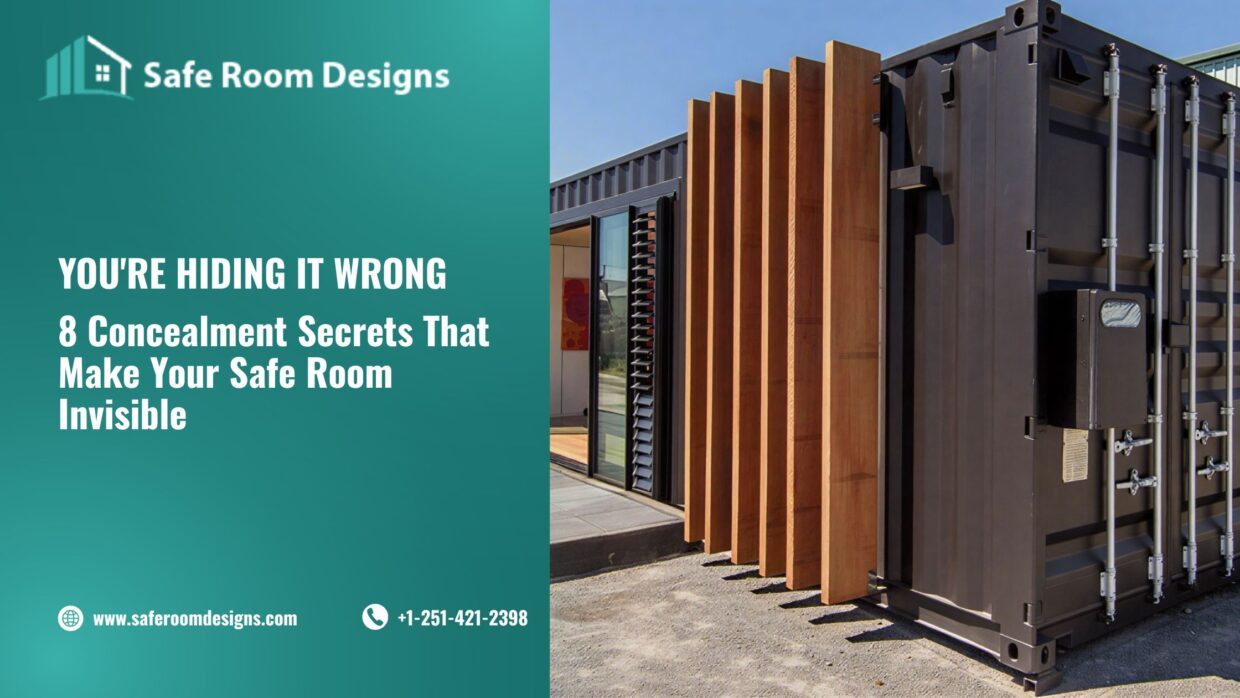
You’re Hiding It Wrong: 8 Concealment Secrets That Make Your Safe Room Invisible
Post Tags:
The biggest mistake homeowners make when building a safe room isn’t the door thickness or the lock type. It’s that the room looks like a safe room.
A reinforced steel door at the end of a hallway. A room with no windows that doesn’t match the rest of the house. A suspiciously thick wall. These are giveaways — and they defeat the entire purpose of a hidden safe room.
The best panic rooms in the world share one quality: nobody knows they exist until they need to. Here’s how designers achieve that.
What Is Safe Room Concealment — and Why Does It Matter?
Safe room concealment refers to the architectural and design strategies used to disguise a secure room as an ordinary part of a home. The goal is to prevent a threat actor — whether an intruder, burglar, or other — from identifying the room’s existence during a break-in.
Research into home invasions shows that most intruders spend less than 10 minutes inside a property. A concealed safe room buys time. A visible one invites direct attack.
1. The Bookcase Door: Still the Gold Standard
Hidden bookcase doors remain the most popular concealment method — and for good reason. They blend naturally into libraries, home offices, and living spaces. Modern bookcase doors are flush-mounted, spring-loaded, and open with a concealed magnetic key or hidden touch panel. When closed, they look and feel like a fixed piece of furniture.
The key detail most people miss: the books and shelves on the bookcase door must match the surrounding shelving perfectly. A single height or style mismatch draws the eye.
2. The Fireplace Pivot Wall
In luxury homes, a full-width fireplace wall that pivots to reveal a safe room is increasingly common. The fireplace itself is functional — it produces real heat, has real ash — which makes it one of the most convincing disguises available. The pivot mechanism is typically hydraulic, triggered by a hidden switch or biometric reader embedded in the mantle.
3. Under the Staircase (Not Where You Think)
Most people think ‘under the stairs’ means a small cupboard. Professional designers think differently. A staircase with a rising tread mechanism — where the entire staircase swings outward on a pivot — reveals a full-size room beneath. This works especially well in homes with wooden staircases on a ground or first floor.
4. The Closet Conversion With a False Back Wall
Walk-in wardrobes are ideal for concealment. A false back wall — built 60–90cm inside the rear of the closet — hides the safe room entrance entirely. Clothes hang in front of the false wall. The entry mechanism is typically a specific combination of clothes rail or shelf movements that trigger the wall to release.
5. Match the Door Hardware Exactly
One of the most overlooked details in safe room concealment is door hardware. If every door in your home has aged brass lever handles, your concealed safe room door should have the same. A single door with different hinges, handles, or a slightly different finish breaks the illusion immediately.
6. Soundproofing That Doesn’t Look Like Soundproofing
Safe rooms require acoustic insulation to prevent sound from escaping during an emergency. But visible acoustic panels on walls immediately signal a room is different. The solution is to use insulation within the wall cavity itself, combined with standard plaster or decorative panelling on the surface.
7. Control the Lighting Signature
A safe room with no windows will have a different light signature from outside the home at night. Designers solve this by installing LED strips behind frosted glass panels on exterior-facing walls — panels that look like windows from outside but are sealed and non-functional.
8. The Utility Room Strategy
Positioning a safe room adjacent to — or accessed through — a utility room, boiler room, or plant room is highly effective. These spaces are naturally avoided by intruders, have plausible reasons for reinforced walls and unusual doors, and often have no windows.
Frequently Asked Questions
Can a safe room be completely undetectable?
With professional design and construction, yes. A well-concealed safe room using pivot walls, matching hardware, and integrated lighting is virtually undetectable without specialist equipment.
Does concealment affect the protection level?
Not at all. Concealment is purely an exterior design strategy. The structural strength, door rating, and locking systems inside are independent of how the room is disguised.
How much does concealment add to the cost?
Concealment typically adds 20–35% to the base cost of a safe room. A basic bookcase door concealment starts around £3,000–£8,000. Full architectural concealment can add £15,000–£40,000 to the project.
What’s the most common concealment mistake?
Using a door that doesn’t match the home’s existing doors. Hardware, finish, and door thickness should be identical to every other door in the house.
Thinking about a safe room that no one will ever find? Our design team specialises in fully integrated concealment — built into your home’s architecture from day one. Contact Safe Room Design for a private consultation.


Recent Blog Posts
-

-
-
-
How to Choose the Right Tiny Home Builder
05-08-2026
-
-
-
-
-
-
How Much Does a Tiny Home Really Cost?
22-07-2026